

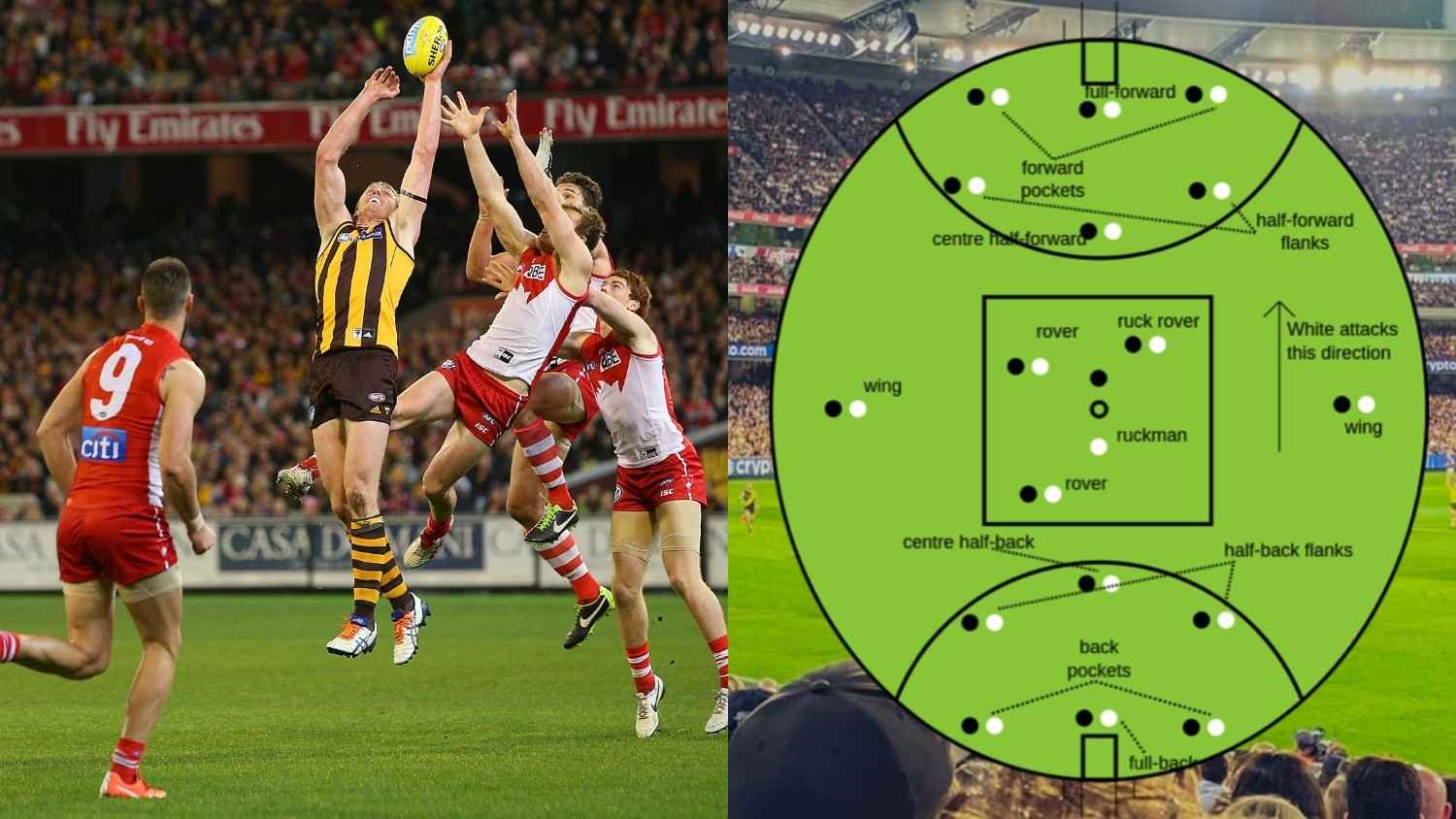
Australian Rules Football has been shaped by over 160 years of continuous evolution. From its earliest days in 1858, when matches had no time limit and tripping was legal, the Laws of the Game have been refined season after season.
The behind scoring system arrived in 1897, interchange benches and 50 metre penalties followed across the decades, and in 2019 the landmark 6-6-6 rule was introduced to crack open defensive gridlock and restore attacking football.
Each change reflected the game growing smarter, safer, and more watchable. Today, the Laws exist to reward players who make winning the ball their primary objective.
How the Game Is Structured

AFL matches are divided into four quarters, each lasting 20 minutes plus time on. At the start of each quarter and after every goal, play restarts with a centre ball up, where the umpire bounces the ball in the centre circle for the ruckmen to contest.
- Each team fields 18 players on the ground at a time
- Five interchange players sit on the bench and can rotate freely
- A medical substitute can be activated if a player is deemed unfit to continue by the club doctor
How Scoring Works
Scoring in AFL is straightforward in principle but adds layers of strategy to every forward entry. Teams are rewarded differently depending on how accurately they kick the ball between the four goalposts.
- A goal (6 points) is scored by kicking the ball cleanly between the two tall central posts
- A behind (1 point) is scored when the ball passes between a tall and short post, hits a post, or is touched over the line
- The team with the highest total points at the final siren wins the match
How Players Move the Ball
Ball movement in AFL is what makes the game so distinctive and visually spectacular compared to other football codes around the world.

- Players can move the ball by kicking or handballing, which involves holding the ball in one hand and punching it with the other
- Throwing the ball is strictly prohibited and results in a free kick to the opposition
- A player running with the ball must bounce it or touch it on the ground at least once every 15 metres
What Is a Mark?
The mark is one of AFL’s most celebrated features and one of the clearest rewards for clean skill under pressure.
- A mark is awarded when a player catches the ball directly from a kick that has travelled at least 15 metres without touching the ground
- The player is then awarded free possession and opponents must stand back five metres
- Any player within the protected area when a mark is taken must stand still
Tackling and Holding the Ball
Tackling is central to AFL and separates it from many other field sports. Players can be tackled from the front or behind, but only between the shoulders and the knees.
- A player who is legally tackled must immediately kick or handball the ball
- Failing to dispose of the ball correctly results in a holding the ball free kick to the opponent
- A player who shrugs in a tackle is now deemed to have had prior opportunity to dispose
Common Free Kick Infringements
Free kicks are the primary way umpires penalise illegal play and keep the contest fair for both sides.
- Push in the back during a tackle or mark contest
- High contact or high tackle above the shoulders
- Deliberately kicking or handballing the ball out of bounds between the 50 metre arcs
- Tripping an opponent with the foot or hand
- Any player crossing the centre circle line before the ball is contested at a centre ball up
The 50 Metre Penalty
The 50 metre penalty is one of the most significant rulings an umpire can make and can swing momentum instantly.

When a player is awarded a free kick or mark and an opponent infringes before they dispose of the ball, the umpire moves the kick 50 metres closer to goal.
This rule encourages opponents to respect the contest and gives the attacking team a significant scoring opportunity as a result.
Suggested Reads:
The Rule Change That Made Headlines: The 6-6-6 Rule
By the mid-2010s, defensive flooding had strangled the game. Coaches were pushing nine or ten players behind the ball at centre bounces, scoring dropped to historic lows, and fans grew frustrated watching gridlocked football.
The AFL responded ahead of the 2019 season with the 6-6-6 rule, requiring each team to position exactly six players in their forward 50, six in their defensive 50, and six in the midfield corridor at every centre bounce.
The impact was immediate. Scoring surged, forwards found space they had not seen in years, and the spectacle returned. While some coaches argued it restricted tactical freedom, the numbers backed the decision. It remains the most consequential single rule change of the modern AFL era.