
Australian rules football uses one of the most unique scoring systems in world sport. Unlike most ball sports where a goal equals a single unit, the AFL awards six points for a goal and one point for a behind, creating scorelines that confuse newcomers but thrill fans who understand the nuances.
Beyond match scoring, the AFL also operates a Draft Points system for player recruitment, a Player Points System for community leagues, and a separate Fantasy scoring system that drives one of the most popular fantasy sports games in Australia.
Here is everything you need to know about how points work across every level of the AFL.
AFL Match Scoring System: Goals and Behinds
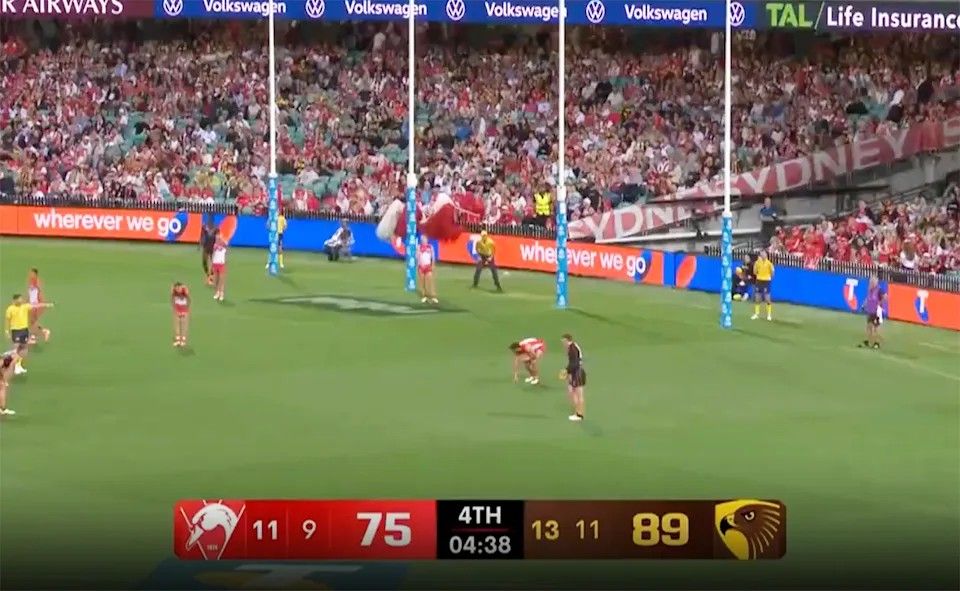
The AFL match scoring system is built around two types of scores. A goal is worth six points and a behind is worth one point. The total score is displayed in a unique format that no other sport uses.
How Goals and Behinds Work
| Score Type | Points | How It Happens |
|---|---|---|
| Goal | 6 points | Ball kicked entirely over the goal line between the two taller central posts |
| Behind | 1 point | Ball passes between a goal post and behind post, hits a post, or is touched before crossing the goal line |
| Rushed Behind | 1 point | Defender intentionally forces the ball over their own goal line |
How to Read AFL Scores
AFL scores are displayed in a Goals.Behinds (Total Points) format. This confuses many international viewers at first but becomes second nature quickly.
Formula: Total Points = (Goals x 6) + Behinds
Example: 12.9 (81) means 12 goals and 9 behinds. That equals (12 x 6) + 9 = 81 total points.
Here are some real examples from the 2026 AFL season to illustrate how the system works in practice.
| Match (2026) | Team 1 Score | Team 2 Score | Result |
|---|---|---|---|
| Round 1 | Hawthorn 21.19 (145) | Essendon 13.5 (83) | Hawthorn won by 62 points |
| Opening Round | Sydney 20.12 (132) | Carlton 10.9 (69) | Sydney won by 63 points |
| Round 2 | Gold Coast 19.14 (128) | Richmond 9.6 (60) | Gold Coast won by 68 points |
Key Point: A team can kick fewer goals but still win if they have significantly more behinds. However, this is extremely rare at AFL level because the six point goal advantage is massive.
Goal Umpire Decisions
Every scoring shot is reviewed by the goal umpire who stands behind the goals. In the 2026 season, the AFL Review Centre (ARC) can also review scoring decisions using technology. The goal umpire signals a goal by pointing both index fingers forward, and a behind by pointing one finger up.
AFL Draft Points System (Value Index)
The AFL Draft Points system assigns numerical values to every draft pick. This system is primarily used for father son and academy player bidding, allowing clubs to match bids using the combined value of their existing picks.
How Draft Pick Values Work
| Pick Number | Points Value |
|---|---|
| Pick 1 | 3,000 |
| Pick 2 | 2,517 |
| Pick 3 | 2,234 |
| Pick 4 | 2,034 |
| Pick 5 | 1,878 |
| Pick 10 | 1,313 |
| Pick 20 | 638 |
| Pick 30 | 350 |
| Pick 40 | 194 |
| Pick 50 | 111 |
Father Son and Academy Bidding
The draft points system becomes most relevant during father son and academy nominations. Here is how it works in practice.
- A club nominates a father son or academy player before the draft
- Other clubs can bid on that player during the draft
- The nominating club has the right to match any bid using their existing picks
- A 20% discount is applied to matched father son bids, meaning the club needs fewer points to secure their nominated player
- If the club cannot match the bid with their available picks, the player goes to the bidding club
Example: If Pick 4 (2,034 points) is bid on a father son player, the nominating club only needs to match 80% of that value, which equals 1,627 points. They can combine multiple lower picks to reach this total.
Player Points System (PPS) For Community Leagues
AFL community leagues across Australia use a Player Points System to manage talent distribution and encourage local player development. Leagues like AFL Queensland and AFL Victoria implement this system to ensure competitive balance at the grassroots level.
Player Categories and Points
| Category | Points | Player Description |
|---|---|---|
| Category 1 | 1 point | “Home” players who have played multiple seasons at the club |
| Category 2 | 2 points | Players who have played 1 to 2 seasons at the club |
| Category 3 | 3 points | Players transferring from another club in the same league |
| Category 4 | 4 points | Players from interstate or higher level competitions |
| Category 5 | 5 points | Players with recent state league experience |
| Category 6 | 6 points | Players who have played AFL in the previous three seasons |
How the Team Cap Works
- Each senior team has a total point cap, typically 45 to 50 points for their top level team
- Clubs must ensure their selected team does not exceed this cap on match day
- Category 1 players (local, long term club members) are the cheapest at 1 point each
- Category 6 players (recent AFL experience) cost the most at 6 points each
- This system rewards clubs that develop local talent rather than recruiting outsiders
Purpose: The PPS prevents wealthy clubs from hoarding talent and ensures that community football remains competitive across all regions. It also incentivises former AFL players to return to their original local clubs rather than moving to the strongest team in their area.
AFL Fantasy Scoring System
AFL Fantasy is the official fantasy sports game that runs alongside the Toyota AFL Premiership Season. Coaches build squads of 30 players under a salary cap and earn points based on real on field performances.
Fantasy Points Per Action
| Stat | Points Awarded |
|---|---|
| Kick | 3 points |
| Handball | 2 points |
| Mark | 3 points |
| Tackle | 4 points |
| Free Kick For | 1 point |
| Free Kick Against | -3 points |
| Hitout | 1 point |
| Goal | 6 points |
| Behind | 1 point |
Fantasy Classic vs Fantasy Draft
| Feature | Fantasy Classic | Fantasy Draft |
|---|---|---|
| Salary Cap | $17,800,000 | No salary cap |
| Squad Size | 30 players | Varies by league |
| Player Ownership | Multiple coaches can own the same player | One player belongs to one team only |
| Weekly Trades | 2 per week (3 during byes) | Trade with league mates |
| Best For | Individual competition | Head to head with mates |
How to Build a Fantasy Classic Squad

Your squad consists of 30 players across five positions.
- 8 Defenders
- 10 Midfielders
- 3 Rucks
- 8 Forwards
- 1 Utility (any position)
Of these 30 players, 22 are on field scorers each week. The remaining 8 sit on the bench as cover for injured or rested players.
Fantasy Scoring Strategy
The key to AFL Fantasy is finding players who accumulate stats efficiently. Midfielders typically score the highest because they record the most disposals (kicks and handballs), marks, and tackles.
- Premium players like Nick Daicos ($1,074,000) need to average 104+ points per game to justify their price
- Mid priced players like Clayton Oliver ($797,000) need around 78 points per game
- Basement rookies like Sam Davidson ($230,000) only need 22 points per game to provide value
- Best value stats: Tackles (4 points each) and marks (3 points each) are the most underrated scoring actions
Suggested Reads:
Conclusion: Four Points Systems That Power Australian Football
The AFL operates four distinct points systems that each serve a different purpose. Match scoring with its six point goals and one point behinds creates the unique scorelines that define Australian rules football.
The draft points value index ensures fair player recruitment through father son and academy bidding. The Player Points System keeps community football competitive at the grassroots level.
Additionally, AFL Fantasy gives fans a personal stake in every match through its detailed statistical scoring system. Understanding all four systems gives you a complete picture of how Australian football works from the MCG to your local suburban ground.